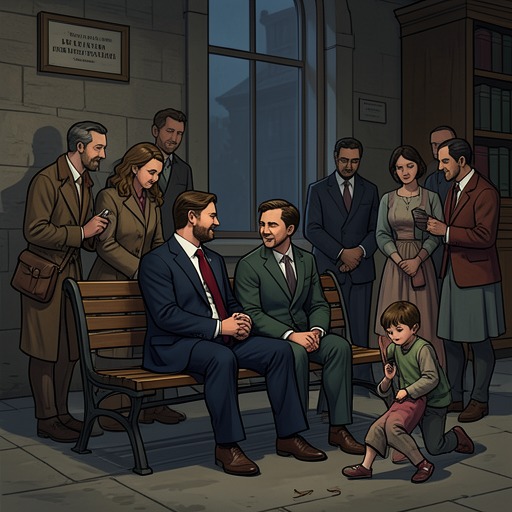
J.D. Vance and Usha’s reconciliation at Ford’s Theatre
Hillbilly ElegyJ.D. Vance and Usha’s reconciliation at Ford’s Theatre interrupts a familiar pattern of anger and flight. After Vance lashed out at Usha and walked away, memories of his mother and grandmother helped him see his own behavior as part of a family inheritance. Usha’s response—firm about the need to talk, but neither punitive nor retaliatory—made a different ending possible.
Background and Immediate Conflict
During Vance’s second year of law school, he and Usha traveled to Washington, D.C., for follow-up interviews with several law firms. He returned to their hotel room discouraged after performing poorly in an interview with a firm he particularly wanted to join. Usha tried to reassure him: she suggested that the interview might have gone better than he thought and that other opportunities remained if it had not.
Vance reacted as though reassurance were an excuse for failure. He shouted at Usha, accused her of making room for weakness, and left the hotel. The scene joins professional disappointment to an intimate conflict: instead of receiving comfort, he treated it as a challenge to the standards by which he judged himself. His anger drove him out of the room, but the walk that followed gave him time to recognize what his departure resembled.
The Walk and the Family Pattern
For the next couple of hours, Vance walked through the business district. He remembered an earlier flight from conflict: after a screaming match with Bob Hamel, his mother had taken him and their toy poodle to Middletown’s Comfort Inn. They stayed there for several days, until Mamaw persuaded his mother to return home and face her problems. The memory gave his own departure a family precedent, while also recalling that someone had once urged his mother not to keep running.
His thoughts widened to his mother’s childhood. She had run out the back door with her mother and sister to avoid another night of terror with her alcoholic father. Vance understood himself as a third-generation escaper: in different circumstances, three generations had responded to conflict by leaving. The recognition did not erase the differences between their experiences, but it made his walk more than a temporary retreat. He had become frightened by the likeness between his conduct and the behavior he associated with his mother.
Ford’s Theatre and Recognition
Near Ford’s Theatre, where John Wilkes Booth shot Abraham Lincoln, Vance passed a corner store selling Lincoln memorabilia. A large inflatable Lincoln, wearing an exaggerated grin, struck him as an absurd and unsettling image beside the site of the president’s assassination. Vance wondered at the grin and at the incongruity of cheerfulness so near a place associated with death. The detail punctuates his walk with an image of a smile that seems out of place, while his own thoughts remain fixed on the damage that anger can do within a family.
After turning a corner, he saw Usha sitting on the steps of Ford’s Theatre. She had run after him because she was worried about him being alone. Her presence brought the argument back from the family past to the relationship in front of him. Vance recognized that he had a problem, and that he needed to confront what had led generations of his family to hurt the people they loved. The location thus becomes the place where a chain of remembered escapes meets a present opportunity not to repeat one.
Apology and Reconciliation
Vance apologized profusely. He expected that Usha would reject the apology, condemn him, and make reconciliation difficult. That expectation reflected the punitive logic he had learned to associate with conflict: a sincere apology meant surrender, and surrender invited an attack. Usha did not follow that script. Through tears, she told him that running away was unacceptable, that she had been worried, and that he needed to learn to talk with her.
Her response combined a clear boundary with care. She did not treat his departure as harmless, but she also did not prolong the argument or turn his apology into an opportunity to punish him. She hugged him, accepted the apology, and expressed relief that he was safe. The immediate conflict ended there. The reconciliation is significant not because the disagreement disappears, but because the exchange concludes without the retaliatory escalation Vance had anticipated.
Significance
Vance describes Usha as someone who had not learned to fight in the hillbilly school of hard knocks. Elsewhere, his account of visiting her family for Thanksgiving emphasizes the contrast: he was struck by the absence of familiar accusations and angry family exchanges, and by the affection with which her parents spoke about relatives. That contrast gives the Ford’s Theatre scene a broader context. Usha’s response came from a different model of family conflict, one in which concern and a direct request to communicate did not require either surrender or attack.
The episode changes Vance’s understanding of his own conduct. Rather than cast the scene only as another argument, he identifies his act of leaving as a repetition of a multigenerational pattern and accepts that he must address it. Usha’s pursuit and his apology do not resolve the family history behind the pattern; they mark a moment in which he can recognize it and begin to respond differently.